
In 1968, the PLO adopted a revised National Charter that defined all of Mandatory Palestine as a single, indivisible national territory and rejected any political arrangement recognizing Israel. This framework guided the organization’s territorial project in the 1970s, when the leadership sought to align armed struggle, diplomacy, and governance with the Charter’s principles. After 1973, the PLO introduced the idea of establishing a “national authority” on any territory evacuated by Israel, presenting it as an initial stage rather than a territorial compromise. This phased approach preserved the Charter’s maximalist horizon but aimed to secure a concrete foothold in the West Bank or Gaza, a prospect rejected by Israel and viewed cautiously by several Arab states.

In July 1968, the Palestine Liberation Organization adopted a revised National Charter that transformed the Palestinian question into a clearly defined territorial claim over all of Mandatory Palestine. The Charter’s opening articles declared Palestine to be the homeland of the Arab Palestinian people and affirmed that the territory, within the boundaries it had under the British Mandate, constituted an indivisible territorial unit. This formulation rejected earlier ambiguities about borders and anchored Palestinian nationalism in a precise cartographic frame: the whole of the land between the Jordan River and the Mediterranean Sea, including Jerusalem, was claimed as a single Arab space to be liberated and reunified.
For the PLO, this territorial definition was not merely descriptive but programmatic. The Charter insisted that the Palestinian people possessed an inalienable legal right to their homeland and to exercise self-determination there after liberation. In practice, this meant that any partition of Palestine, any recognition of Israel’s sovereignty, or any solution that confined Palestinians to the West Bank and Gaza Strip was deemed illegitimate. The territorial vision implied by the Charter therefore rejected existing armistice lines and post‑1948 borders, treating them as temporary products of occupation rather than as foundations for future political arrangements.
The Charter also specified the means by which this territorial project was to be pursued. Armed struggle was defined as the sole road to the liberation of Palestine, and commando action was presented as the nucleus of a broader popular liberation war. In this framework, the entire territory of Mandatory Palestine was imagined as a single battlefield and a single future polity, not as a mosaic of potential compromises. The emphasis fell on historical, demographic, and symbolic connections to cities such as Jaffa, Haifa, Lydda, and Jerusalem, which were presented as integral components of the national space.
At the same time, the Charter’s emphasis on Palestinian identity and continuity gave this territorial claim a distinctly national character. Palestinians were defined as those who had resided in Palestine until 1947 and their descendants, while Jews who had lived there before the beginning of the Zionist invasion could be considered Palestinians. This formulation reinforced the idea that the land’s legitimate political community was Arab and Palestinian, and that the envisioned national territory represented the restoration of an interrupted historical order rather than the creation of a new state. The Charter thus fused territory, people, and history into a single nationalist claim.
By the early 1970s, this territorial imagination continued to shape PLO discourse even as tactical debates emerged about possible interim arrangements on any liberated part of the territory. Yet the underlying horizon remained the same: a unified Palestinian entity replacing the existing territorial configuration. The vision articulated in the 1968 Charter therefore expressed not only a maximal territorial demand but also the core ideological grammar of Palestinian nationalism in this period—indivisible land, exclusive national title, and liberation conceived as the reconstitution of a single, undivided homeland.
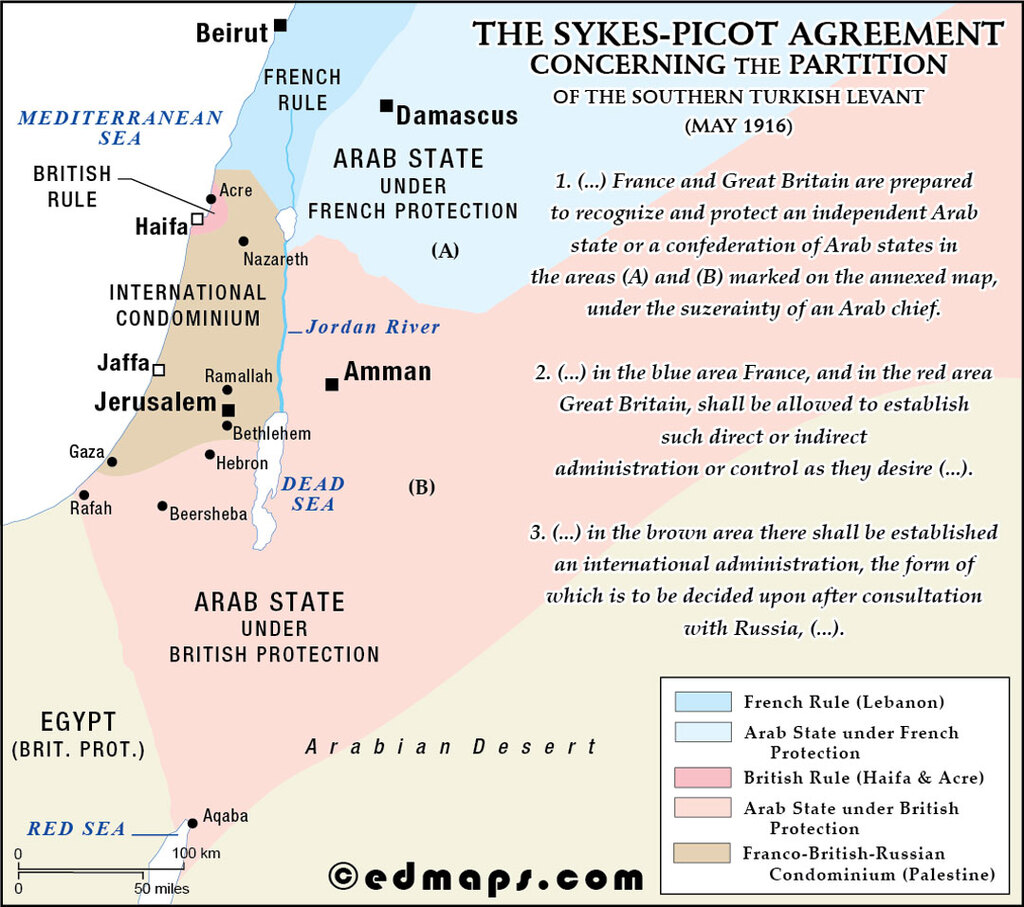
This agreement divided Ottoman Middle East territories between Britain and France, creating spheres of influence in modern-day Syria, Iraq, Lebanon, and Palestine.
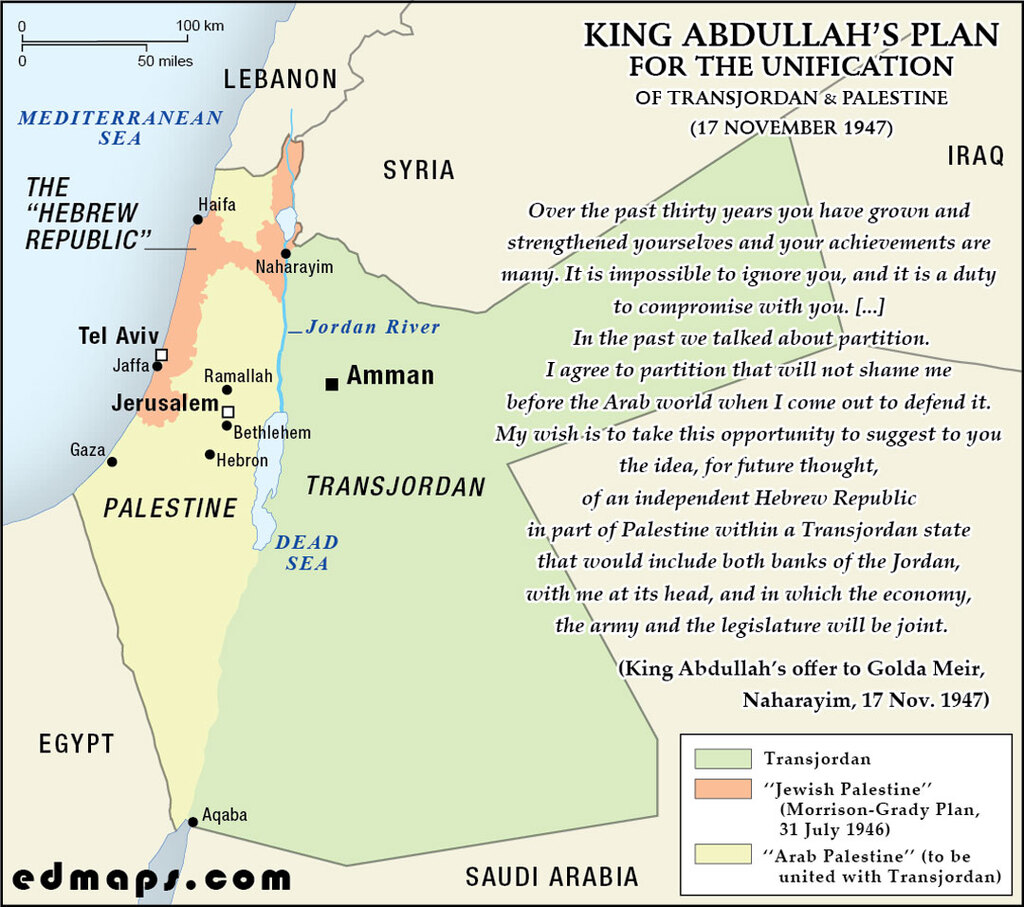
In 1947, King Abdullah I proposed annexing Arab Palestine to Transjordan, offering Jewish autonomy within an enlarged kingdom, rejected by Zionists seeking an independent state.
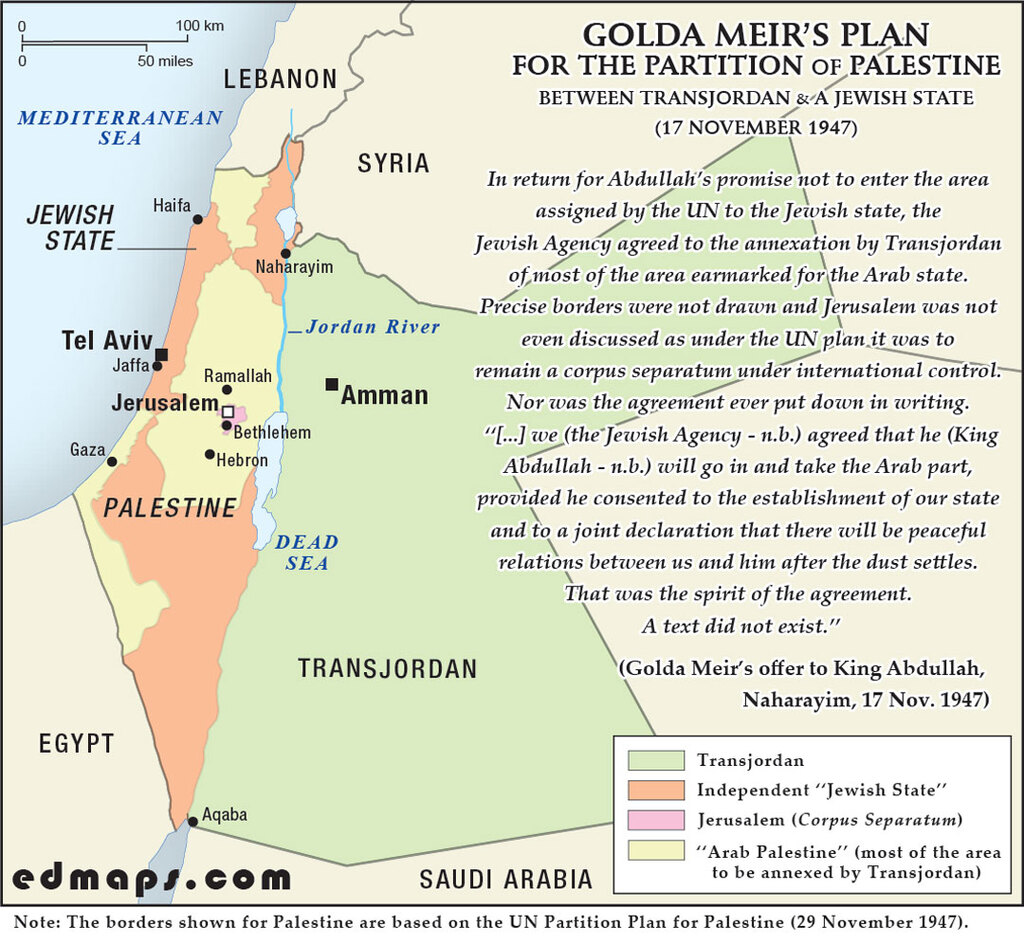
Golda Meir, representing the Jewish Agency, supported the UN Partition Plan (1947), advocating for an independent Jewish state alongside an Arab state in Palestine and Transjordan.